
Trends and Skills Intelligence
The mobility ecosystem is undergoing a profound transformation.
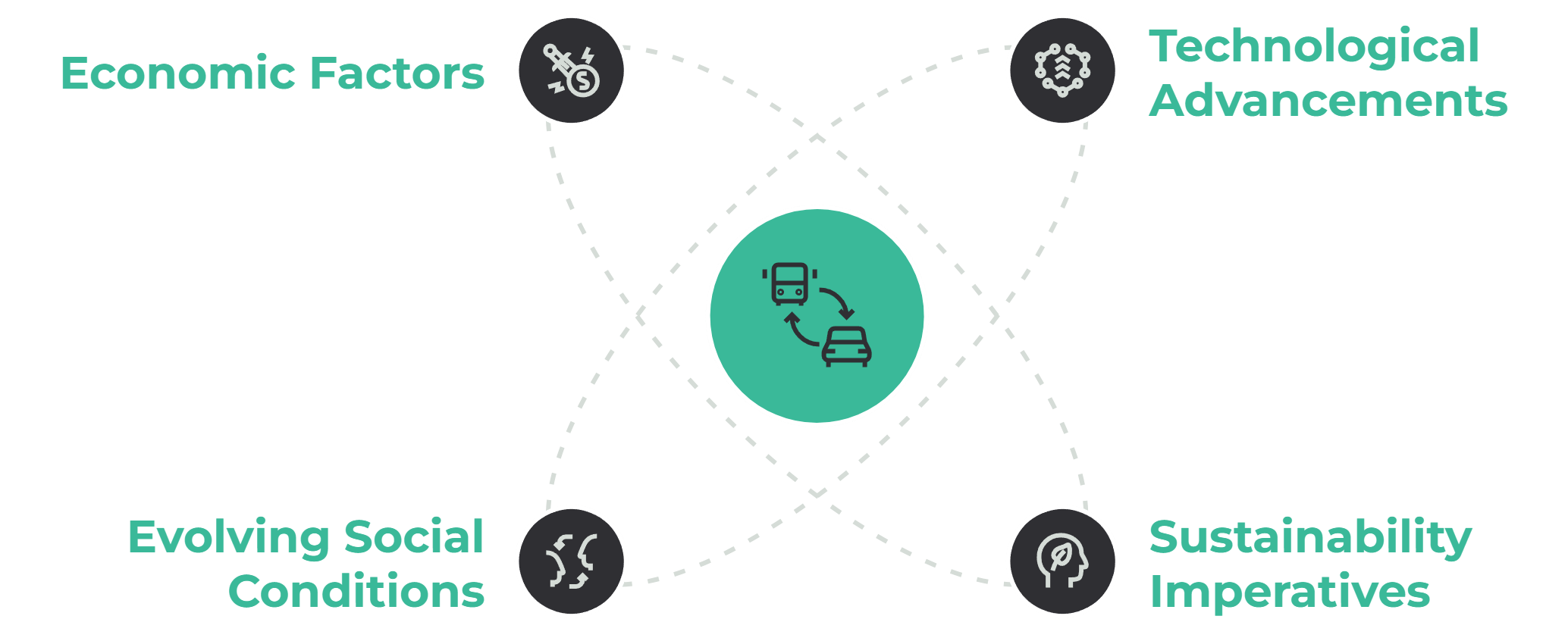
The sector is being shaped by four interconnected forces: technological advancements, economic developments, sustainability imperatives, and evolving social conditions. Together, these drivers are accelerating the adoption of new mobility solutions, transforming value chains, and redefining workforce requirements. As innovation, digitalization, and the green transition continue to gain momentum, organisations and individuals must develop new capabilities, adapt to emerging trends, and strengthen collaboration to ensure a competitive, sustainable, and future-ready mobility ecosystem.
The Automotive Skills Alliance (ASA) plays a central role in understanding these dynamics and translating then into actionable insights for skills development.
We provide sectoral intelligence, develop skills frameworks, and support the design of flexible, future-proof training and education. Our approach is collaborative, evidence-based, and deeply embedded in the needs of industry and workers.
ASA
Skills Intelligence & Trends
At ASA, skills intelligence is the result of a systematic process that combines:
- Monitoring megatrends and sectoral trends in mobility, technology, and sustainability
- Mapping current and emerging job roles
Identifying skills needs at technical, behavioural, and systemic levels - Analysing the gaps in current education and training provision
- Supporting the development of modern, responsive learning pathways
This intelligence informs training design, curriculum updates, career guidance and policy-making across the automotive and mobility ecosystem
Trends Shaping the Sector
We cluster trends into four key dimensions
Digitalisation
AI, machine learning, data analytics, connectivity, autonomous systems, cybersecurity
Top trends by relevance: AI/ML (67.6 %), Connected Vehicles (40 %), Autonomous Driving (37.1 %)
Green Transformation
Electromobility, energy systems, hydrogen, sustainable materials, circular economy
Top trends by relevance: Electromobility (66.7 %), Circular Economy (52.4 %), Hybrid Vehicles (34.3 %)
Social & Economic Change
Gen Z expectations, new work and learning models, globalisation, agile workplaces
Geopolitical & Value Chain
Pressures
Supply chain resilience, raw material access, shift from “Made in China” to “Made in Europe”
All these impact what jobs exist, how they evolve, and what skills are required.
Job Roles Intelligence
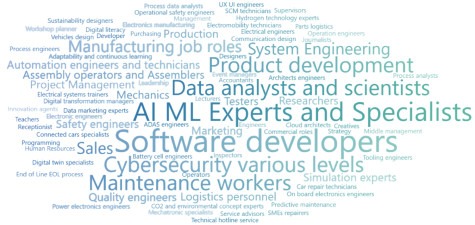
Digital and green transitions are reshaping nearly all roles in the ecosystem.
Roles most impacted by digitalisation:
- Software Developers
- AI/ML Specialists
- Cybersecurity Experts
- Data Analysts & Scientists
- Automation Engineers
- Digital Twin and Simulation Experts
Roles most impacted by sustainability trends:
- Energy Engineers
- Vehicle Mechanics (especially electric/hydrogen)
- Green Transformation Specialists
- Maintenance Workers
- Circular Economy & Process Engineers
These roles require new hybrid skillsets blending engineering, IT, sustainability and soft skills
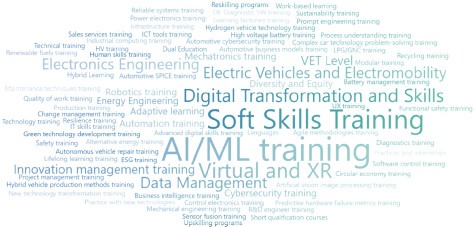
Skills View - Core Skills Clusters
Technical
Big Data, System Integration, AI, Materials Science, Mechatronics, Power Electronics
Green
Battery systems, Hydrogen, Sustainability management, Circular design
Digital
Software Development, Automation, Cybersecurity, Simulation
Soft/Transversal
Learnability, Adaptability, Creativity, Collaboration, Problem Solving
Hard vs. Soft Skills
Today’s work reality demands a blend: technical excellence is vital, but must be accompanied by behavioural agility and communication skills to enable cross-functional collaboration and lifelong adaptability.
From Skills Intelligence to Education & Training
The pace of transformation challenges traditional training systems. Based on our intelligence, we observe.
Key challenges:
- Slow adaptation of curricula
- Limited capacity for reskilling/upskilling
- Fragmented training offers lacking agility
- Recognition gaps in non-formal or micro-credentialed learning
Key responses:
- Design of modular, flexible training formats
- Development of micro-credentials
- Promotion of stackable learning paths
- Use of digital learning, VR/AR, simulators, and hybrid formats
- Focus on outcomes-based recognition of skills
The (R)evolution in education is not optional - it is a strategic necessity
Sectoral Intelligence from Projects
Below is a curated selection of key ASA and partner projects contributing to the Skills Intelligence ecosystem. Each entry includes direct links to project results.